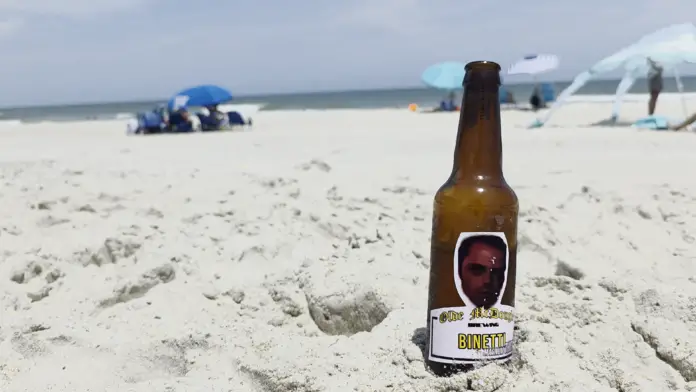
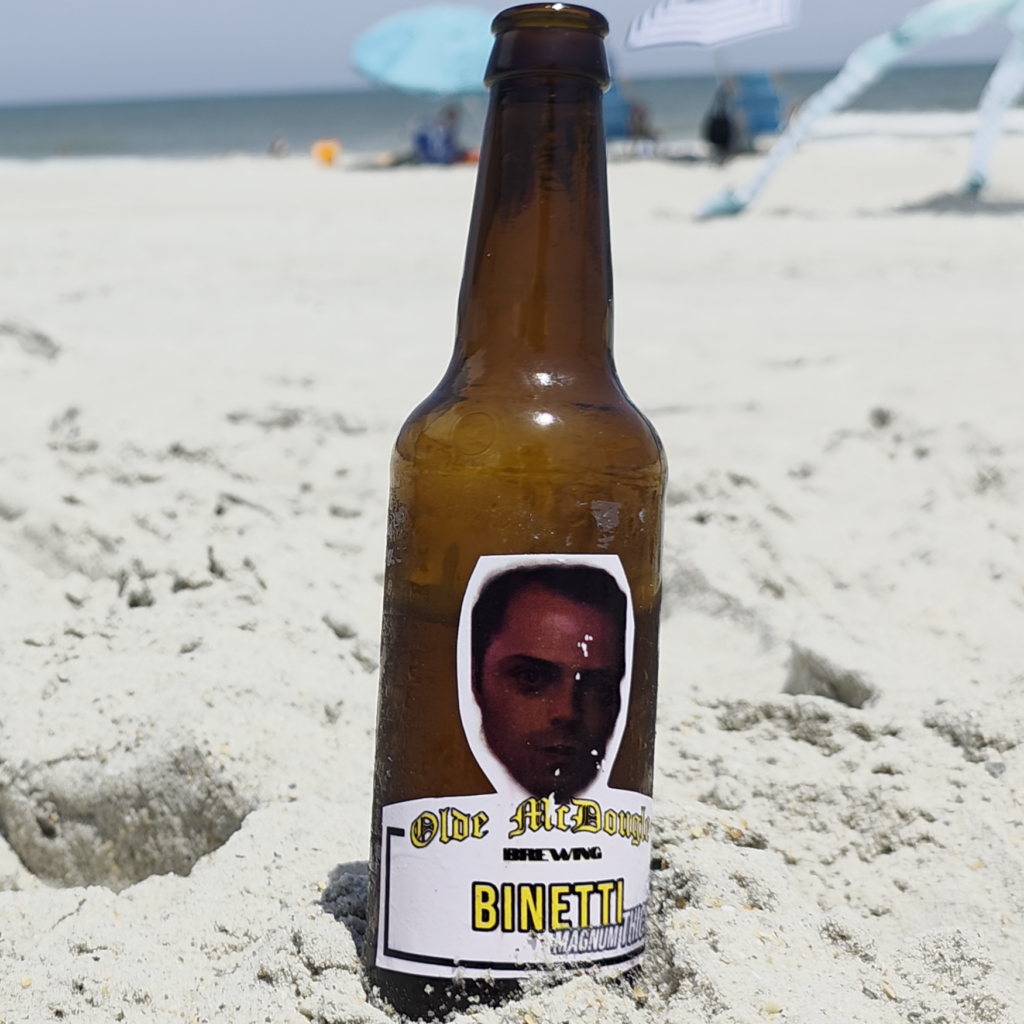
My buddy, Mark, got married this year, and for his bachelor party, we had a beach trip with the guys. It wasn’t the only bachelor party in the group this year, but it was the only one local enough to drive to – and the perfect opportunity to brew up a beer for the guys to enjoy.
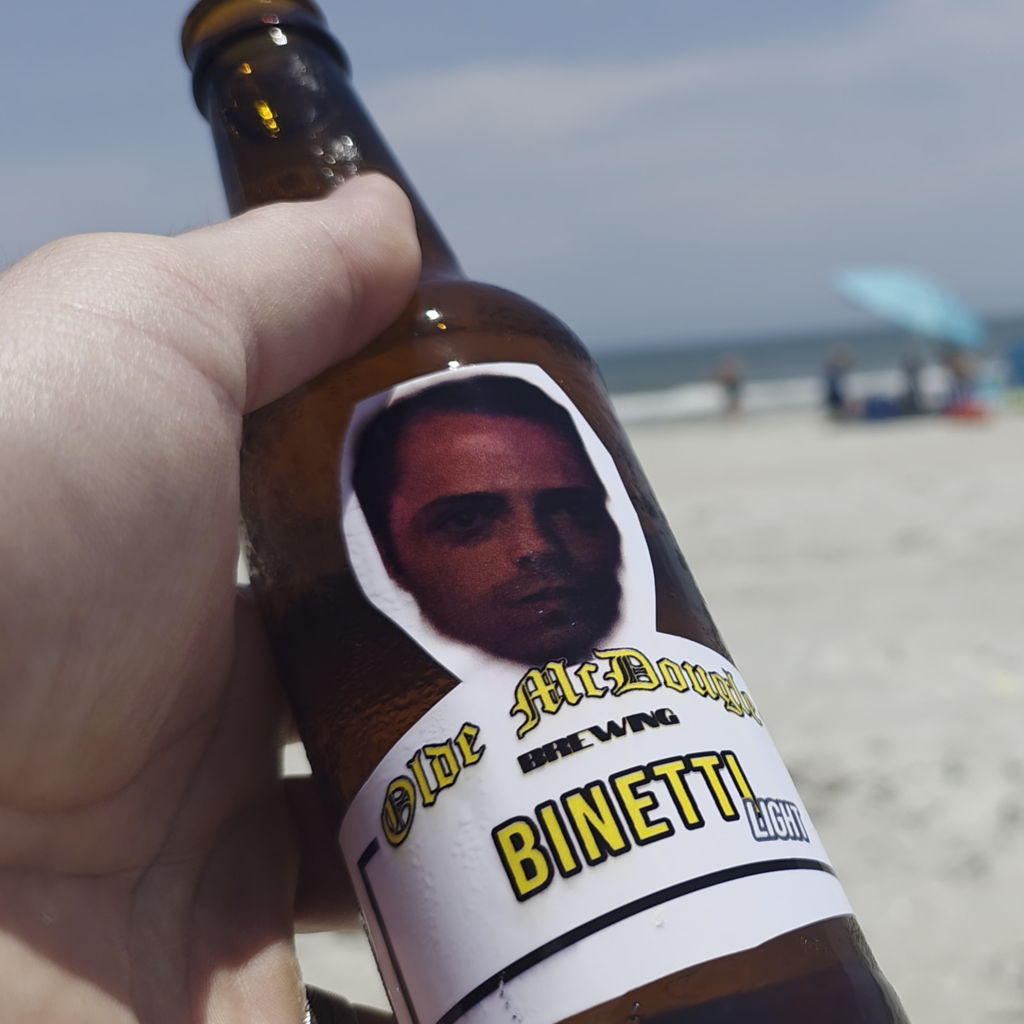
It’s the same group as the fantasy football league, so I thought I’d make the same beer that went over so well at last year’s draft party: a hoppy, corn-adjunct lager, somewhere between a Mexican lager and a hoppy pilsner. That beer was just kind of thrown together from whatever I had on hand – so this time I built the recipe intentionally, from the ground up. And I put Mark’s face on the label.
This recipe is an iteration on that draft party beer – same grain bill, similar hop schedule, improved process. I took what I learned from that beer and applied it to this one – and then, made a second batch from the lessons I learned from the first batch! That first batch had a real problem – here’s what that problem was, and how I fixed it.
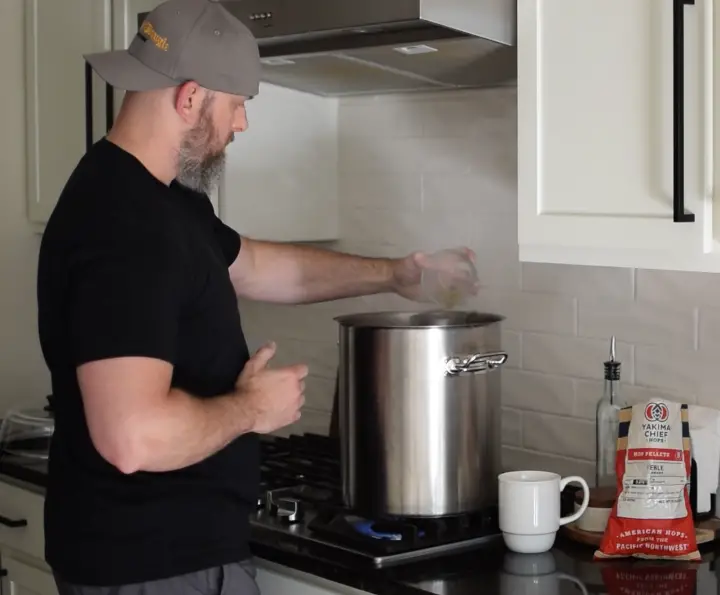
Go watch the video for the full details: a step-by-step how-to-brew, an actual tasting with full tasting notes, and even a side-by-side comparison against commercial and craft beers that you might recognize.
The Real Culprit: DMS (and Why It Tastes Like Plastic, Not Corn)
Both the original beer for the fantasy draft party and the first iteration of this beer (batch 1) had a slight off-flavor: slightly plastick-y and a little phenolic. At the time, I thought it was the yeast – specifically, I thought that pressure fermenting Lutra, a kveik yeast that doesn’t need pressure to ferment clean, pushed it towards “low-temperature” off-flavors. It made sense at the time.
However, when fermenting this beer at a very low pressure did not fix the issue, I knew that I had the wrong diagnosis.
The real issue was DMS: dimethyl sulfide, a sulfur compound that comes from a precursor (SMM) present in malt, especially Pilsner malt. It’s supposed to boil off during the boil, and with most modern, highly-modified malts, it’s not even something you have to think about. That’s why I didn’t consider it at first.
DMS can produce a plasticky note in your beer sometimes. Some malts, like pilsner malt, may require a longer boil.
But I have since learned that with pilsner malt – even highly-modified pilsner malt – it can sometimes still need a longer boil.
Here’s the thing that actually threw me: DMS is usually described as giving the beer a “cooked corn” flavor, and any “corn” flavor in this beer could have just as easily come from the actual corn in the mash.
However, at very, very low concentrations, DMS can actually taste like plastic!
I learned this little nugget of information thanks to the work I’ve been doing on building a rules engine for the diagnosis tool in my new homebrewing app suite, BrewLab, which is currently in development.
The solution to DMS is simple: just boil the wort longer. So for that reason, one of the biggest improvements I made in the second version of this beer was to simply increase the boil time from a standard 60 minutes to 90+ minutes.
The Recipe
Both batches use the same grain bill and a very similar hop schedule. Ultimately, it’s not really two distinct recipes, it’s one recipe with minor tweaks and a huge correction.
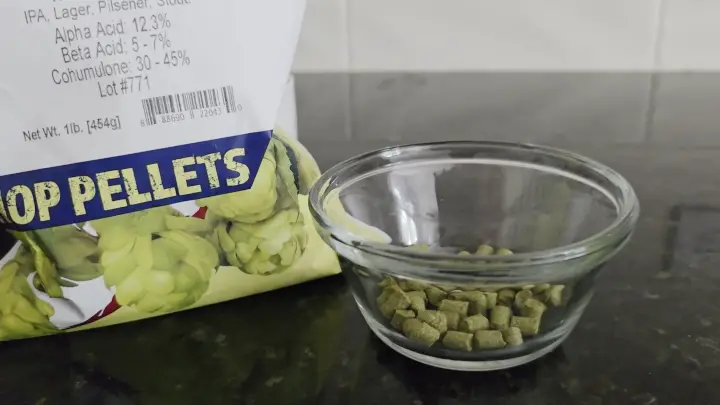
The primary difference in the recipe (process corrections aside) is the bittering hop: using a different bittering hop actually has a fairly meaningful impact on the overall flavor profile, as I talked about in the video. Neither choice is better or worse, just different.
Regardless of which recipe you choose to follow, be sure to use the 90-minute boil
BeerHoppy Corn Lager
Binetti Light
This is batch one of the Binetti bachelor party beer – the first version of the recipe, showcasing a softer, sweeter hop character from the Perle hops. The standard boil length led to an issue that was corrected in the second version.
Aside from a few process changes to fix issues like DMS, the main difference between these batches is the bittering hop.
BeerHoppy Corn Lager
Binetti Magnum Thick
This is batch two of the Binetti bachelor party beer – the second version of the recipe, showcasing a cleaner, more bitey bitterness from the Magnum hops. The longer boil length and some minor water chemistry corrected some of the issues from the earlier version.
I added a tiny amount of gypsum to brighten the water, but that was specific to my water: yours may require something different. I also added ~3ml of lactic acid solution to bring the pH down from 5.8 to 5.2 – this is not a necessary step, but it does improve the result.
Full tasting notes, including side-by-side comparisons with popular commercial and craft beers for reference, are in the video – and I’d go watch that first if you’re interested in brewing the beer!
The short version: these two are more alike than they are different, and the gap between them mostly comes down to the bittering hop.
However, the bittering hop does seem to play differently with the other components of the recipe – in a very interesting way.
The Perle hop used in batch one gives the beer a much softer, sweeter hop character that carries through to the rest of the beer. The Hallertau Blanc floral flavor is more pronounced, and the corn character from the grits presents sweeter.
The Magnum hop used in batch two is cleaner, sharper, and has more bite. It accentuates the woodiness of the Hersbrucker a bit more, and that same corn character reads drier, more husk- or cereal-grain-like.
It’s the same corn from the same grits, it just comes across differently in the different beers.
IMPORTANT NOTE: Whichever flavor profile sounds better to you, be sure to follow batch two’s process! the 90-minute boil is not a style choice – it fixes a real issue. so if you want perle’s softer bitterness, brew it with a 90-minute boil, not a 60-minute one.
Improvements
If (probably when) I brew this again, I definitely have some thoughts.
I think I would try to create a blend of the two somehow – on-camera, I discovered that mixing the beers actually produced something better than either of them on their own.
Additionally, I think a bit more bitterness up front as well as a Saaz addition would really take this beer to a new level.
None of this is planned yet, but if it ever does get made…..
Conclusion
Either one of these beers is incredible on its own – you don’t need a beach trip bachelor party to justify brewing it!
This beer would be great for any kind of hot-weather, outdoor, or casual situation.
But for me? This was built for one specific afternoon on the beach with some of my best friends, and it did exactly what it needed to do. I have a feeling this will be a brew that gets made more often.
The full brew day, the real tasting, and everyone actually enjoying the beer are all in the video above.
Make one of these – or both! – and let me know how it turns out.
As an Amazon Associate, The Ultimate Homebrewer's Guide earns commission from qualifying purchases. This site also participates in affiliate programs with MoreBeer.com and other sites. The Ultimate Homebrewer's Guide is compensated for referring traffic and businesses to these companies.